|
Hey, here's your Weekly Rx. It's time to face the music.
Words Worth Keeping
"You can observe a lot by watching."
— Yogi Berra, who sat behind the plate for 18 seasons
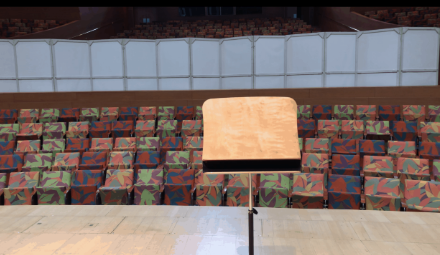
If you can't picture what's on the other side of that screen, we need to chat.
This Week
Try something. Close your eyes. You're at the free-throw line. Playoff game, one second left, down by one. The crowd is screaming. Somebody behind the basket is waving a giant cardboard head at you. Your friends are in the stands.
Now shoot.
You made it, didn't you? In your head, you made it. Easy.
Why? You're not a basketball player. But you've watched a thousand free throws. You know what the knees do, what the arc looks like, the sound the net makes. Your brain has the footage. When the pressure is on, it has something to follow.
Now try it with an audition. Close your eyes and picture the final round. Last excerpt. You're playing it, and you're winning.
Harder, right? Most of you have nothing to picture. You've never heard a winning final round. You've barely heard your own rounds. The nerves wipe the tape. People walk out of an audition with no idea how they played, then go to the next one, and the next one, never quite sure why they don't advance.
You can't aim at something you've never seen.
The Prescription
Back in September I wrote about the day after you don't advance (Issue 011, if you keep these). This one is about why it keeps happening.
I've sat on the other side of the screen. If I could give every conservatory student one thing, it would be an afternoon in that chair. Listen to a hundred flute players play the same excerpts. Something clicks, and it isn't subtle. By the tenth player you can hear who's advancing, and you know why. The time is solid. The articulation is clean. The character is there in the first bar. Everything your teacher has said for years, "your time has to be rock solid," stops being a slogan and becomes the obvious thing it always was.
Forty-nine players make the same mistake, one after the other. Then one doesn't. In that moment it's suddenly obvious what a winning round sounds like. It changes you as a player, not just as a candidate. Once you've heard a tempo drag from the committee's chair, you don't let yours drag again.
Unfortunately, you're probably not going to be invited onto a professional orchestra's committee anytime soon. So build the experience yourself. Four or five people on your instrument. One excerpt, a screen of some kind, a chair on the far side. Take turns listening. Write what a committee writes: advance or not, and one reason. Then switch. Record the whole thing and listen again in a week.
After an hour of that, you'll have footage. The next time you close your eyes before a round, your brain will have something to follow. If you want help setting one of these up, hit reply. I have thoughts.
Hear what winning sounds like before you try to do it.
Hit reply and tell me: have you ever sat on the other side of the screen? What did you hear?
Happy practicing,
Chris @ Honesty Pill Coaching
P.S. Run that mock and you'll hear something in your own playing you want to fix. The 15-Minute Practice Reset is how you fix it without losing a Saturday: five short lessons and a workbook on finding what's actually broken and working on that instead of running the whole excerpt again. It lives inside HPAC, and your first month is free.
Under an hour to watch. Fifteen minutes a day to run. Cancel anytime.
Something land? Something miss? Hit reply. I read them.
| 
